A Rising Tide Lifts All Boats: Why Investing in SNAP is Good Economics
No matter your political leaning, we all understand that people need to eat to survive. How to ensure that a whole country gets fed is where things get complicated. Politicians and policymakers are charged with the monumental task of balancing the immediate needs of people facing hardship with responsible stewardship of taxpayer dollars. They bring their own hard-earned values about the roles of individuals, the government, and community when considering how the country should respond when people struggle to access food.
The Supplemental Nutrition Assistance Program (SNAP) sits at the center of this debate. Determining the scale at which the country invests in SNAP requires considering the program not only through a moral lens, but an economic one as well.
The economic case for SNAP begins with its role in generating income, tax revenue, and jobs, kicking off a multiplier effect that reaches well beyond the household receiving the benefits. The National Grocers Association estimates that, in 2025, SNAP funding was responsible for approximately 388,000 jobs, over $20 billion in direct wages, and over $4.5 billion in local, state, and federal tax revenue.¹ Additionally, USDA research shows that during a slow economy, every $1 billion increase in SNAP benefits generates approximately $1.54 billion in additional GDP and supports about 13,560 additional jobs.² SNAP doesn’t just help redistribute existing dollars; it grows the economy.
SNAP’s economic role is not new; it goes back nearly a century to the first iteration of a nationwide nutrition assistance program, when policymakers recognized that addressing hunger could also help stabilize the agricultural sector. The earliest roots of the program can be traced back to the 1930s, when farm commodity prices fell dramatically during the Great Depression, resulting in an excess supply of crops and livestock at the same time Americans were going hungry. Through the Agricultural Adjustment Act of 1933, the federal government began purchasing surplus commodities and distributing them to those in need through hunger relief agencies, solving two problems with one policy. When the economy was booming after World War II and fewer families needed help putting food on the table, the program shrank.
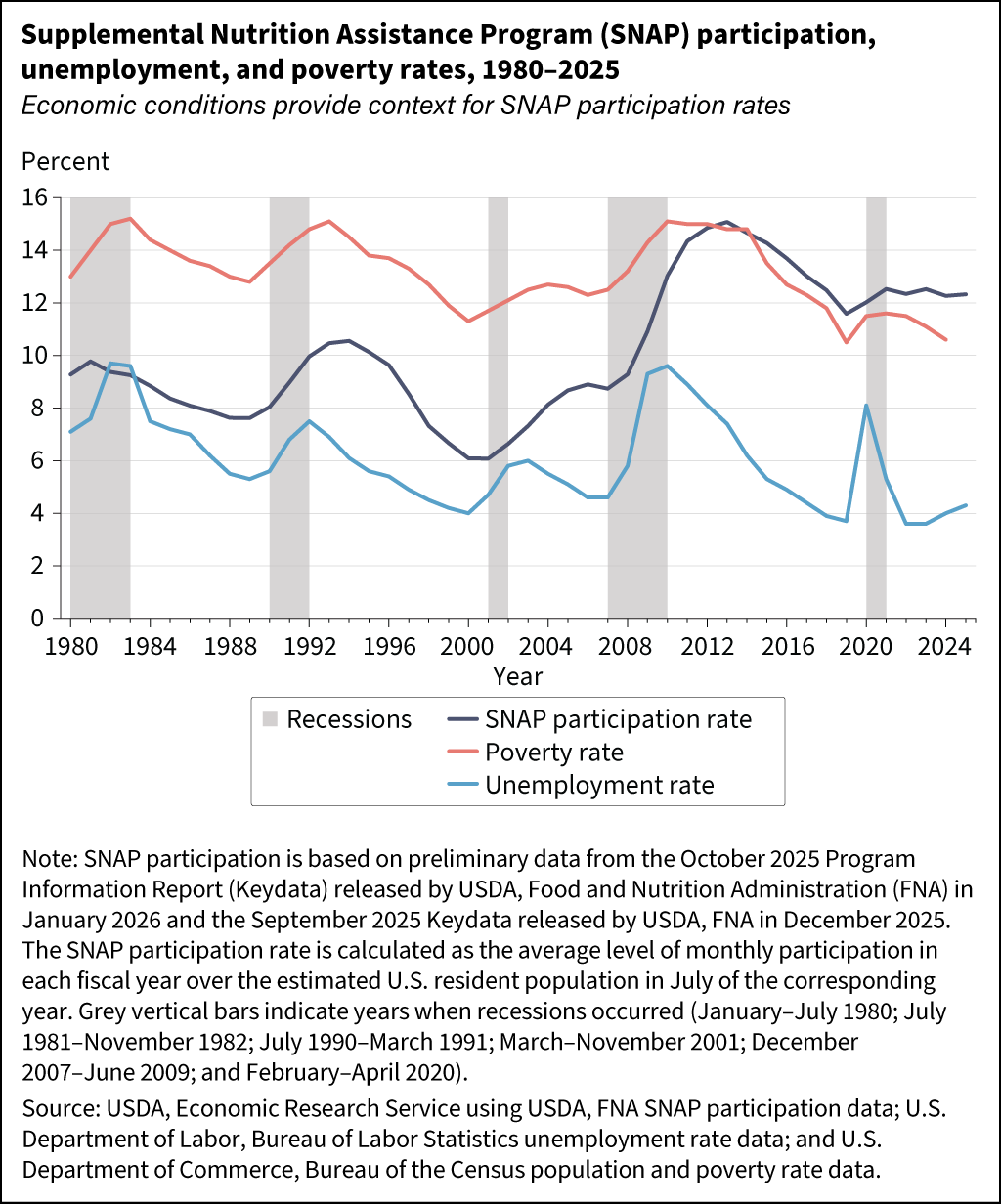
The first permanent Food Stamp Program was enacted in 1964, and participation has continued to ebb and flow since then. The program’s responsive design is spelled out clearly by the USDA: “SNAP is one of the Nation’s primary countercyclical Government assistance programs… the program provides assistance to more low-income households during an economic downturn or recession and to fewer households during an economic expansion, serving as an automatic stabilizer to the economy.” ³ Investing in SNAP protects Americans during periods of both economic downturn and prosperity.
That built-in responsiveness is a strength of SNAP, and it works best when the program itself remains stable. Yet SNAP has become more politically charged than ever. New legislation can significantly change the program every election cycle, adding complexity and requiring federal and state agencies to spend time and taxpayer dollars updating systems, revising guidance, and retraining staff. Constantly changing a program already designed to respond to economic conditions makes the program less efficient for everyone.
SNAP’s economic value becomes especially visible when considered at the household level. Take Andrew, married and a father of two, whose household receives $600 in monthly SNAP benefits, or roughly $150 per week. That benefit is designed to supplement, not replace, his family’s food budget: the USDA estimates that a family of four averages a grocery bill of $236-$380 per week.⁴
Each week, he starts at the farmers market, where he buys fresh produce, eggs, and locally-raised beef for his family while putting money directly into the hands of farmers he knows and trusts. The market participates in Double Up Food Bucks, a program supported by public-private partnerships to encourage SNAP spending on healthy food options. Andrew spends $50 of his SNAP benefits at the market and the program provides him an additional $50 to spend on eligible fruits and vegetables.
From there, Andrew heads to a local grocery store and spends $100 of his SNAP benefits stocking up on staples like rice, fruit, cereal, and other foods, using his earnings to cover the rest of the bill. Combined with his own out-of-pocket spending, SNAP allows Andrew to buy the foods that fit his family’s diet, allergies, and preferences.
With his family’s basic food needs taken care of, Andrew can focus his time, finances, and energy on the training he needs to obtain a higher-paying job. As his income increases, his benefit amount will gradually decrease. This structure supports economic mobility: Andrew doesn’t have to turn down a promotion for fear of being kicked off the program entirely. SNAP’s design allows Andrew to avoid falling off the “benefits cliff” as he moves towards greater financial independence.
In just two stops, Andrew’s SNAP benefits have supported an entire supply chain while helping put food on his family’s table. Farmers, manufacturers, processors, distributors, warehouse workers, truck drivers, and retailers all benefited from that investment.
Additional USDA research shows that SNAP spending can have an outsized impact in rural communities.⁵ Because agriculture often makes up a large share of rural economies, SNAP benefits spent on local produce and at local retailers can be especially impactful. SNAP is a critical piece of our country’s infrastructure, keeping both rural and urban economies moving.
Conversely, food insecurity carries its own economic and social costs. Here are a few examples:
Research consistently finds that food-insecure households have higher healthcare costs.⁶⁻⁸ Low-income adults who participated in SNAP had approximately $1,400 less in annual healthcare expenditures.⁹ These findings suggest that addressing food insecurity may reduce both public and private healthcare costs.
A 2019 study found removing food assistance from convicted drug felons increased recidivism rates, particularly for financially-motivated crimes.¹⁰ Consider the cost to citizens and the criminal justice system when desperation to feed one’s self and family may push people back into crime.
A large, peer-reviewed study found that children who had greater access to food assistance before age five experienced higher rates of economic self-sufficiency as adults.¹¹ Food-secure children become adults who contribute to our society as workers, taxpayers, parents, consumers, and community members.
Investing in SNAP now can mitigate higher downstream costs down the road, reducing pressure on healthcare systems, public services, and local economies.
SNAP puts purchasing power into the hands of consumers who spend it quickly, drives activity throughout the supply chain, creates jobs, generates tax revenue, encourages economic mobility, and may reduce costly outcomes in other areas of the economy.
For decades, lawmakers across the political spectrum have worked together to refine SNAP, adapting the program to balance fiscal responsibility with the needs of people facing hardship. Its bipartisan history is a reminder that the question has never been whether the SNAP program should exist, rather how to make it work better. Policymakers must ensure that SNAP continues to exist in every community in America.
“Whatever it is, the way you tell your story online can make all the difference.”
References
National Grocers Association. (2025, May 6). New economic data underscores SNAP’s critical role in supporting American jobs and local economies.
Canning, P., & Stacy, B. (2019, July). The Supplemental Nutrition Assistance Program (SNAP) and the economy: New estimates of the SNAP multiplier (Economic Research Report No. ERR-265). U.S. Department of Agriculture, Economic Research Service.
U.S. Department of Agriculture, Economic Research Service. (2025, July 24). Supplemental Nutrition Assistance Program (SNAP).
U.S. Department of Agriculture, Food and Nutrition Administration. (2026, August 26). USDA food plans: Monthly Cost of Food Reports.
Vogel, S., Miller, C., & Ralston, K. (2021, October). Impact of USDA's Supplemental Nutrition Assistance Program (SNAP) on rural and urban economies in the aftermath of the Great Recession (Economic Research Report No. ERR-296). U.S. Department of Agriculture, Economic Research Service.
Berkowitz, S. A., Seligman, H. K., Meigs, J. B., & Basu, S. (2018). Food insecurity, healthcare utilization, and high cost: a longitudinal cohort study. The American Journal of Managed Care, 24(9), 399–404.
Palakshappa, D., Garg, A., Peltz, A., Wong, C. A., Cholera, R., & Berkowitz, S. A. (2023). Food insecurity was associated with greater family health care expenditures in the US, 2016–17. Health Affairs, 42(1), 44–52.
Johnson, K. T., Palakshappa, D., Basu, S., Seligman, H., & Berkowitz, S. A. (2021). Examining the bidirectional relationship between food insecurity and healthcare spending. Health Services Research, 56(5), 864–873.
Berkowitz, S. A., Seligman, H. K., Rigdon, J., Meigs, J. B., & Basu, S. (2017). Supplemental Nutrition Assistance Program (SNAP) participation and health care expenditures among low-income adults. JAMA Internal Medicine, 177(11), 1642–1649.
Tuttle, C. (2019). Snapping back: Food stamp bans and criminal recidivism. American Economic Journal: Economic Policy, 11(2), 301–327.
Bailey, M. J., Hoynes, H., Rossin-Slater, M., & Walker, R. (2024). Is the social safety net a long-term investment? Large-scale evidence from the Food Stamps program. The Review of Economic Studies, 91(3), 1291–1330.